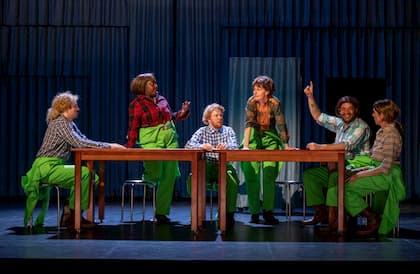
On 26 March 2026, Suze Milius’s new show is premiering at the Bourla: ALL TOGETHER NOW! For those who do not know her work, the following is a good overview of her oeuvre, published by Lietje Bauwens in April 2018. A voyage of discovery through the work of this talented director.
How do you manage within ten minutes to make people feel like they are part of a family, form a bond with strangers on a bus, or behave like an audience in a TV studio? With productions like TALK SHOW, Exhibit and Huis, theatre maker Suze Milius from House Crying Yellow Tears creates fictitious situations in which spectators are confronted with each other, the surroundings and their own reactions.
A Milius show begins long before you enter the designated space, be it a theatre, house or bus station. Through the use of architectural (but certainly not merely three-dimensional) structures, visitors are prepared for the story, or ‘their’ story, preferably from the moment they purchase a ticket. “You could call it an installation process,” declares the director. “I start by putting myself in the position of the audience: What do I want to bring about? What are they supposed to experience? From there I work back, step-by-step, to long before the show officially begins.” In this process, the surroundings play such an important role that they often become her point of departure. “I like the idea of a ‘situational space’: a space that is designed so carefully that the story arises from it naturally, as it were.”
Welcome to the human zoo, one of Milius’s older projects, is a good example of such ‘installation work’. The show takes the form of a collective bus trip to a utopian world. Before the trip begins, the participants are subjected to a bureaucratic procedure in which they relinquish their old identities and everyone is given the same surname. The group has their photo taken; someone’s birthday is celebrated with a song – all of these things being carefully thought-out ways to subtly yet effectively get the ‘spectators’ to form a bond with each other. When, forty minutes later, the bus is attacked by ‘guerrilla fighters’, the sense of solidarity among the passengers is so strong that they react in spontaneous, instinctive ways to absurd threats and social experiments.
Milius once started a course of study in anthropology, but decided to continue her research on the (re)organization of groups and the instincts of the observing/participating person within a theatrical context. Before creating her shows, but also during them, she continually tests how to guide and beguile viewers; she then applies her findings to subsequent projects. “I investigate the spectator’s expectations and desires and then, on the basis of generalizing hypotheses, try to direct people’s behaviour – and thus reality, in fact.” Instead of seeing the dynamics of social relationships as limiting, Milius believes that freedom consists of manipulating those dynamics. She therefore creates a space in which not only she as the maker but also the participants have control over structures. “I think it’s important that my spectators see themselves in a different way. That they participate as well as observe, and sometimes reflect on that dual position in the moment itself.”
Similar to what happens in Welcome to the human zoo, the audience is also played against itself in Exhibit. After the spectators have visited an exhibition and looked at the works of art, they take a seat on a set of bleachers. Then ‘the curtain falls’ and the first group on the bleachers sees a second group of spectators looking at art. The people in group two feel they are being judged and those in group one recognize themselves, perhaps with feelings of shame, in the viewing behaviour now taking place on stage. The performance then continues in this setting; a performance that would not have been possible without the spectators’ having become aware of their own unwitting performativity.
Huis, a show for one person, begins for Milius as soon as the ticket is bought: the participant receives a personal text message with instructions. A key has to be picked up at a little neighbourhood café. Once there, the spectator immediately starts doubting reality. Is the barman playing a role? Why is that woman in the corner staring at me for so long? Has the show already started? A little while later, the spectator enters the door of a house. Merely by means of infrastructural choices, in other words without the physical presence of actors or a director, Milius leads the spectator from room to room. The fact that a light is on in that corner, or that a magazine is lying on that particular bench is no coincidence – all of this is the result of a long investigation into how to manipulate the spectator’s inclinations and curiosity. “Often the biggest challenge is figuring out how to make the visitor feel safe, surrender to it, participate.” But Huis is designed in such a way that a passive spectator influences the course of the performance just as much as an active one, and so it is not a question of participating or not, but of how one participates.
Once the penny has dropped – which happens at a different moment for everyone – and the visitor realizes that he or she plays a (leading) role in the family living in this house, a 45-minute-long family scene begins. Visitors who have children themselves will relate to this on an entirely different primal level than those who, for instance, have experienced a miscarriage or grew up without parents. And so Milius herself constantly observes a new story, one that may unfold within her carefully set parameters, but which, due to the fundamental awkwardness and discomfiture of people, has an infinite number of unpredictable outcomes.
Like in Huis, Milius works in Zwischen with an actual family, in this case the family of Kris Cuppens. Together with the son, daughter, father and grandfather, she explores what it actually means to be a ‘father’ or ‘half-sister’. What makes a home a home? What does ‘coming home’ mean? What rituals are associated with this and how might they actually be broken? Questions such as these run like a red thread through Milius’s oeuvre. Her latest project, TALK SHOW, builds on this by returning to the familiar activity of watching talk shows, the well-known television personalities who reappear every day.
Whereas Exhibit and Welcome to the human zoo encourage and play on the participants’ feeling of being part of a group, the individual visitor to Huis is left to their own devices upon abruptly being snapped out of their role as they stand at the door and see ‘their’ family driving away. Here Milius relinquishes control, and in an identity-less limbo between fictional and actual reality, the visitor has complete freedom to close the door at once or to postpone going home for a while. The visitor is forced to reflect upon their own position of being a spectator without being able to immediately discuss or compare it with anybody. The unnaturalness of this situation becomes apparent in the reactions to Huis that Milius receives by way of, among other things, cards handed out afterwards. Both the spectators and some of the family members feel abandoned, want to share their experiences, see the families again and meet other visitors. However, this desire to organize such a ‘reunion’ is diametrically opposed to what Milius attempts to convey in Huis: emotionally embrace the fleeting moment, and then let go of it.
This fascination with the melancholy of the exclusivity of the ‘now’ is present in all of Milius’s work, and is essentially about zooming out and reflecting on all of the lives one might have had. For Milius, this has a hopeful connotation: “For me, melancholy is bliss, precisely because I feel, precisely because I reflect.” An analysis of spectatorship could easily be seen as a banality, but for Milius it is a sincere attempt to explore the subject further. The Exhibit visitor’s reflection on his or her own art-viewing mannerisms, for example, is more than just an ironic critique of the art world or its behavioural norms; it is an ode to art (objects) and the possibility of experiencing art with a new sense of wonder.
An introduction to the work of Suze Milius
Coming soon to the Bourla: ALL TOGETHER NOW!
Suze Milius employs a visual and physical theatrical language that focuses on interpersonal behaviour in all of its awkwardness and discomfiture. Since 2013, she has worked as a director in both Flemish and Dutch theatre. In 2018, she won the Erik Vos Award for outstanding young directors. The jury report praised her “empathetic and rich understanding of interpersonal exchange” which is “new, convincing and interesting.” The jury wrote: “With a keen eye for theatrical details in everyday life and for the absurd, Suze Milius offers her audience a compelling and compassionate view of human behaviour. The precision and wealth of details with which her actors portray the characters and scenes sometimes make it seem as if they had studied their roles during the rehearsal period as intently as an art class studies its models.”